

.jpeg)
Many piping systems include components that don’t fit squarely into the standard fittings covered by the B31J-2023 SIF tables. Large branch intersections, vessel nozzles, jacketed piping transitions, Wyes, and other project-specific details often fall into the “unlisted” category where the Code allows the use of more applicable analytical methods. In these situations, finite element analysis provides a practical way to quantify how the actual geometry responds to bending, pressure, and axial loads.
As modern tools make it straightforward to extract localized stresses and flexibilities directly from the component, engineers can develop SIFs that reflect the real behavior of the configuration rather than relying solely on generalized tabulated values.
How the B31.3 Framework Uses SIFs
Within B31.3, Appendix D was removed, replaced with ASME B31J. In this document, SIFs differ depending on loading:
- ii for in-plane bending
- io for out-of-plane bending
- it for torsion
The SIFs shown below are not part of ASME B31J Table 1-1:
- ip sometimes interpreted as a pressure-related multiplier
- ia for axial
The axial intensification factor effectively applies to both axial load and longitudinal pressure terms. Code notes also permit ia to be taken equal to io in many practical cases. For standard elbows, tees, and fittings within the tested dimensional range, often being in a low D/T ratio (approximately 20) this structure continues to serve its purpose reliably.
However, when a component’s geometry falls outside the tabulated categories, its actual local response to bending, axial load, and pressure may differ in ways the Code equations do not directly capture. FEA helps clarify those differences.
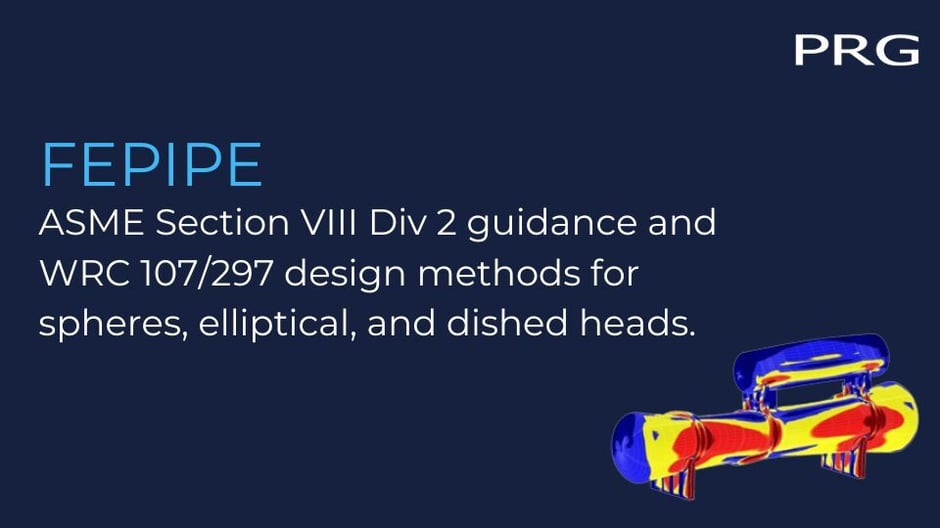
What FEA Shows at Branch Connections and Intersections
When an intersection is evaluated using elastic finite element analysis, three consistent behaviors emerge:
1. Branch-side and run-side intensification can differ substantially.
In reduced branches, the branch may show markedly higher bending or axial intensification than pressure intensification, while the run may display the opposite relationship.
2. Pressure does not always intensify stresses in the same proportion as bending or axial load.
Depending on the component’s diameter, thickness, and reinforcement, the pressure-related intensification may be lower, comparable, or higher than the bending or axial SIF. There is no single scaling factor that applies universally.
3. Size-on-size intersections follow unique patterns.
When the branch and run share equal thickness, branch-side ia and io may correlate well, while the pressure intensification can remain lower. On the run side, the relationships rearrange again.
These observations reflect the natural variation of real geometries. They also explain why B31.3 permits engineers to use more applicable methods, such as FEA, when dealing with unlisted components or geometries outside the scope of the tables.
What an FEA-Derived SIF Represents
An FEA-based SIF follows a straightforward mechanics definition:
SIF = (local peak stress) / (nominal stress)
with nominal stress defined consistently with beam-theory quantities used in piping analysis:
- Bending: M/Z
- Axial: F/A
- Pressure: typically PD/4t for longitudinal stress evaluation
Peak stress is taken at the location where fatigue damage or local strain accumulation would occur—commonly the weld toe or the junction of the branch and header. This makes FEA-derived SIFs directly relevant for:
- Fatigue range evaluation
- Displacement-controlled (thermal) stress checks
- Combined pressure + external load behavior
- Local strain considerations
- Cases where branch and run behavior diverge
By representing the specific geometry and load path, FEA-derived SIFs fit naturally into the B31.3 calculation framework for unlisted configurations.
How NozzlePRO and FEPipe Support SIF and Flexibility Evaluation
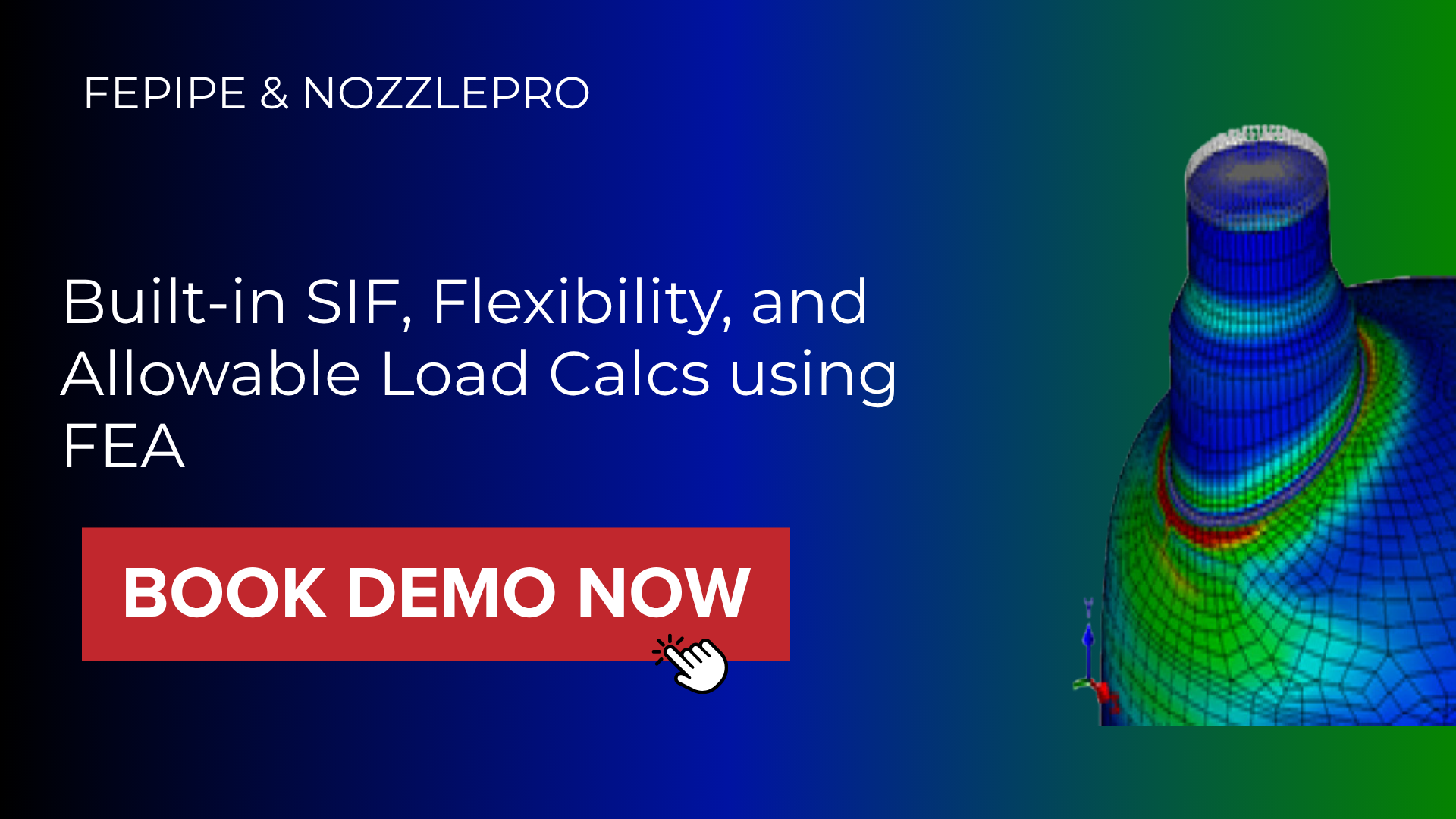
Both of these PRG tools provide built-in capabilities for SIF, flexibility, and allowable load evaluation using detailed finite element analysis.
NozzlePRO
- Automatically evaluates SIFs, flexibilities, and local allowables for unreinforced welded branch connections, pad-reinforced, olet, and similar geometries.
- Offers SIF and allowable load options for pipe shoes and saddles, supporting evaluation of loads through the attachment or through the run pipe or vessel wall.
- Outputs results directly to tables and exportable reports.
FEPipe
- Produces SIFs and flexibilities automatically within its Nozzles / Plates / Shells templates and intersection models.
- Produces SIFs for contoured intersections such as ASME B16.9 and EN 10253-3 welding tees.
- Supports SIF generation for user-defined or advanced geometries—such as mitered elbows, Wyes, jacketed intersections, and conical transitions—via peak-stress extraction and Code-compatible nominal stress definitions.
- Includes recognized stiffness evaluation methods (e.g., WRC 297, NB-3685) for cylinder-on-cylinder cases where applicable.
These capabilities make it possible to characterize unlisted components with the same level of detail used in the underlying FEA, while maintaining consistency with B31.3 usage.
Where FEA-Based SIFs Add the Most Value
FEA-derived SIFs become especially useful when:
- The geometry lies outside the dimensional limits of the B31.3/B31J tables
- Branch and run intensification behavior differs enough that a single SIF is not representative
- Pressure contributes significantly to peak local stress
- Vessel or shell-type deformations influence piping loads at connected nozzles
- Fatigue or displacement-controlled stresses govern the design
- Reinforcement, taper, or thickness transitions strongly affect stiffness
In these scenarios, the component-specific SIF from analysis gives a more direct and reliable representation of how the intersection behaves under the system’s actual loads.
Closing Perspective
The tabulated SIFs in ASME B31J-2023, used by ASME B31.3, remain appropriate for the fittings they were developed to cover. As piping systems incorporate more complex or nonstandard configurations, FEA-derived SIFs extend that framework by representing the actual stress behavior of the specific geometry being designed.
Tools such as NozzlePRO and FEPipe make this process accessible by computing SIFs, flexibilities, and allowable loads directly from finite element models. This provides engineers with reliable, Code-consistent data for evaluating unlisted components while supporting safe and technically sound designs.